
ACTS
The Florida Bar Is Investigating. Here’s What That Actually Means.
Chaz Stevens, CLE Faculty.
February 7, 2026
by Chaz Stevens, CLE Faculty
The Florida Bar Is Investigating. Here’s What That Actually Means.
Today’s mail was not dramatic.
It was procedural.
And that’s exactly why it matters.
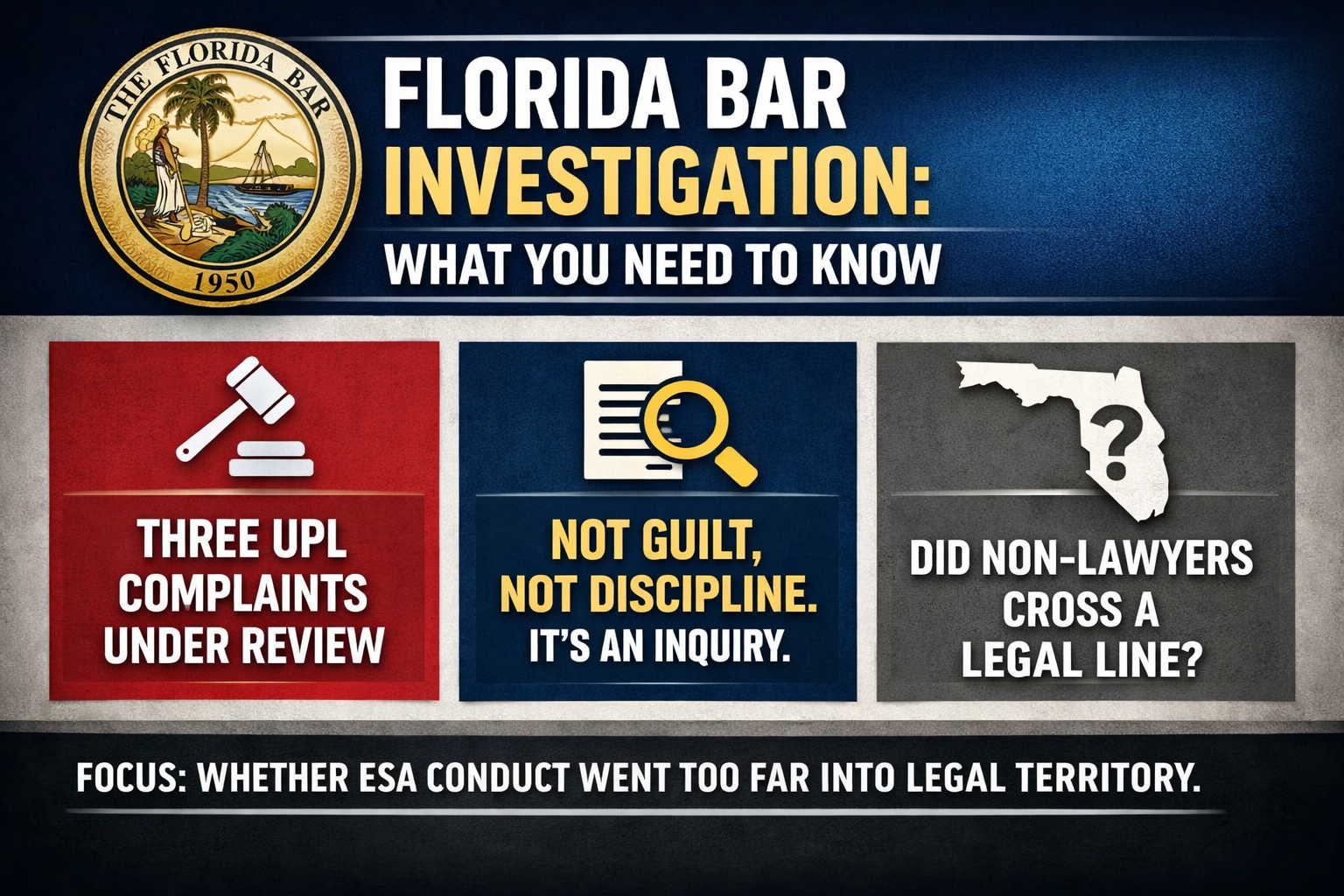
I filed three separate Unlicensed Practice of Law (UPL) complaints with The Florida Bar. This week, I received written confirmation that each complaint has been accepted and is under investigation by the Bar’s UPL Department.
No conclusions.
No outcomes.
Just jurisdiction, intake, and process.
That alone tells you something.
Primary Source Documents
The Florida Bar’s written acknowledgments confirming receipt and investigation of all three UPL complaints are available here:
→ View the Florida Bar Letters (Redacted PDF)
What the Letter Says — and What It Doesn’t
The Florida Bar confirmed receipt of each complaint and stated, plainly, that it is conducting an investigation and will keep me advised of the status.
That’s it.
This is not discipline.
This is not enforcement.
This is not a finding of wrongdoing.
It is the Bar doing its job: determining whether non-lawyers crossed into conduct that Florida law reserves to licensed attorneys.
Why UPL Matters (Especially in the ESA Space)
Unlicensed Practice of Law is not a technicality. It exists to protect the public from legal advice delivered without licensure, accountability, or ethical oversight.
In the ESA ecosystem, the line gets crossed quietly and often.
When non-lawyers:
- Draft legal conclusions about housing rights
- Tell consumers what landlords “must” or “cannot” do
- Sell documents framed as legally sufficient determinations
- Interpret federal HUD guidance as binding state-level mandates
they may not just be mistaken — they may be practicing law without a license.
That question is now formally in front of the Bar.
What Happens Next (Procedurally)
Here’s the part people often misunderstand.
Most UPL complaints do not advance beyond initial intake. They are screened out quickly if the allegations are speculative, conclusory, or outside the Bar’s jurisdiction. Only a small fraction proceed to a formal investigation, which requires a threshold showing that the alleged conduct, if true, could constitute the practice of law by a non-lawyer.
These complaints cleared that bar.
That does not mean a violation occurred.
It means the issues raised are sufficiently concrete, jurisdictionally grounded, and non-frivolous to warrant investigation by Bar counsel.
That distinction matters.
Why This Isn’t About “Winning”
This is not a victory lap.
It’s not a press stunt.
And it’s not about punishment.
It’s about forcing clarity into a space that thrives on ambiguity.
The ESA market has become saturated with legal-sounding claims, authoritative declarations, and documents presented as determinative — often by people who are not licensed to make them.
UPL enforcement cuts through all of that. It asks a narrow, unemotional question:
Were you doing something the law reserves for licensed attorneys?
That question is now being asked — formally.
Bottom Line
The Florida Bar does not open investigations casually.
It also does not prejudge outcomes.
This is the system engaging at the correct layer — not social media, not outrage, not opinion — process.
I’ll update when there is something concrete to update.
In the meantime, these issues — UPL exposure, ESA documentation misuse, and the boundary between guidance and legal advice — are addressed in depth in my ongoing CLE and professional training work. Details will follow as dates are finalized.
Quiet.
Documented.
On the record.
FAQS
Q: Does this mean the Florida Bar found someone guilty of UPL?
A: No. An investigation means the Bar is examining whether alleged conduct could constitute unlicensed practice of law. No conclusions have been reached.
Q: Is an investigation the same as discipline?
A: No. Discipline occurs only after findings and formal proceedings. An investigation is a preliminary, fact-gathering stage.
Q: Why is UPL an issue in the ESA space?
A: Because non-lawyers sometimes issue documents or advice framed as legally determinative, interpret statutes, or present HUD guidance as binding law.
Q: Are HUD guidelines legally binding?
A: HUD guidance is persuasive but not law. Treating it as mandatory legal authority can raise UPL concerns when done by non-lawyers.
Q: What happens next?
A: The Bar reviews facts, evaluates jurisdiction, and determines whether further action is warranted. Many investigations close without enforcement.
About the Author

Chaz Stevens is the founder of REVOLT Training and a longtime public-records strategist focused on forcing accountability through process, not protest. His work has triggered policy reversals, criminal prosecutions, and national media coverage by weaponizing bureaucracy, public records laws, and First Amendment doctrine against institutional dysfunction.
Learn more about him on Wikipedia.
Learn more about him on Wikipedia.
Share
Sedition Isn't Free.
If these words have sparked something in you, help keep the fire burning. Since 2008, My Acts of Sedition (MAOS), the official blog of Revolt Training, is independent, unfiltered, and powered by the community—not corporate interests. Your support directly funds the infrastructure and training needed to turn ideas into action.
Fuel The Revolt
Consent Can™ (Flaccidus Edition)
Satirical political art. Signed artist proof.
The Consent Can (Flaccidus Edition) is a crude, brilliant, and legally-charged object. It’s perfect for the collector who values First Amendment activism over traditional aesthetics. It’s a piece of "Lawful Mischief" that serves as a reminder that the most powerful tool against censorship is often a well-timed joke.
Go ahead, speak your mind.
Recent Musings
March 19, 2026
They Kept 23,000 Records About the Guy Who Tried to Ban the Bible
March 19, 2026
When a Commissioner From Another City Shows Up to Tell Yours to Stay Put — That’s a Records Request

March 11, 2026
[UPDATE]: Heritage Trap: How Florida’s Anti-DEI Law Eats Its Own
![Featured image for “[UPDATE]: Heritage Trap: How Florida’s Anti-DEI Law Eats Its Own”](https://research.revolt.training/wp-content/uploads/2025/10/4def8000-68aa-408a-8b3b-182a70bed3aa.jpeg)
February 10, 2026
The Viewpoint Neutrality Audit

Exposing Hypocrisy
One Story At A Time.
Media Hits
Let me teach you how to get in the news.
Press Hits
We'll Make You A Master Of The Media.
I Asked for an ESA Letter After a 10-Minute Chat. He Said Yes.
By Chaz Stevens Founder, REVOLT Training System Failure Boot Camp™ Want a letter for four emotional…

Investigating ESA Letter Abuse in California
This content is shared for public education, journalistic investigation, and policy advocacy. It includes direct communications…
California’s ESA Letter Scam: 15 Minutes, $149, No Care
This piece is a work of investigative commentary. All opinions expressed are those of the author…
How One Man (and One Bible Ban) Made DeSantis Blink
How Chaz Stevens Weaponizes Communication to Burn Systems Down (and Make DeSantis Blink) Forget influencer fluff.…
Burn the Letter Mill Down: How One $99 ESA Letter Could Crater an Industry.
Ever buy a disability accommodation letter in under 2 minutes? I did. That’s how this story…

I’m calling Austin’s bluff on the Ten Commandments | The Dallas Morning News
by Chaz Stevens Dallas Morning News Soon, Gov. Greg Abbott will sign Senate Bill 10 into…