
ESA Fraud
by Chaz Stevens, CLE Faculty
Texas Didn’t Ban ESA Letter Mills.
It Did Something Smarter.
Everyone keeps asking the wrong question.
“Did Texas just crack down on ESA letter mills?”
No.
And that’s exactly why House Bill 4224 matters.
Texas didn’t attack Emotional Support Animals.
It attacked process integrity—the quiet kind that collapses bad systems without ever arguing about disability law.
The Law (Plain English)
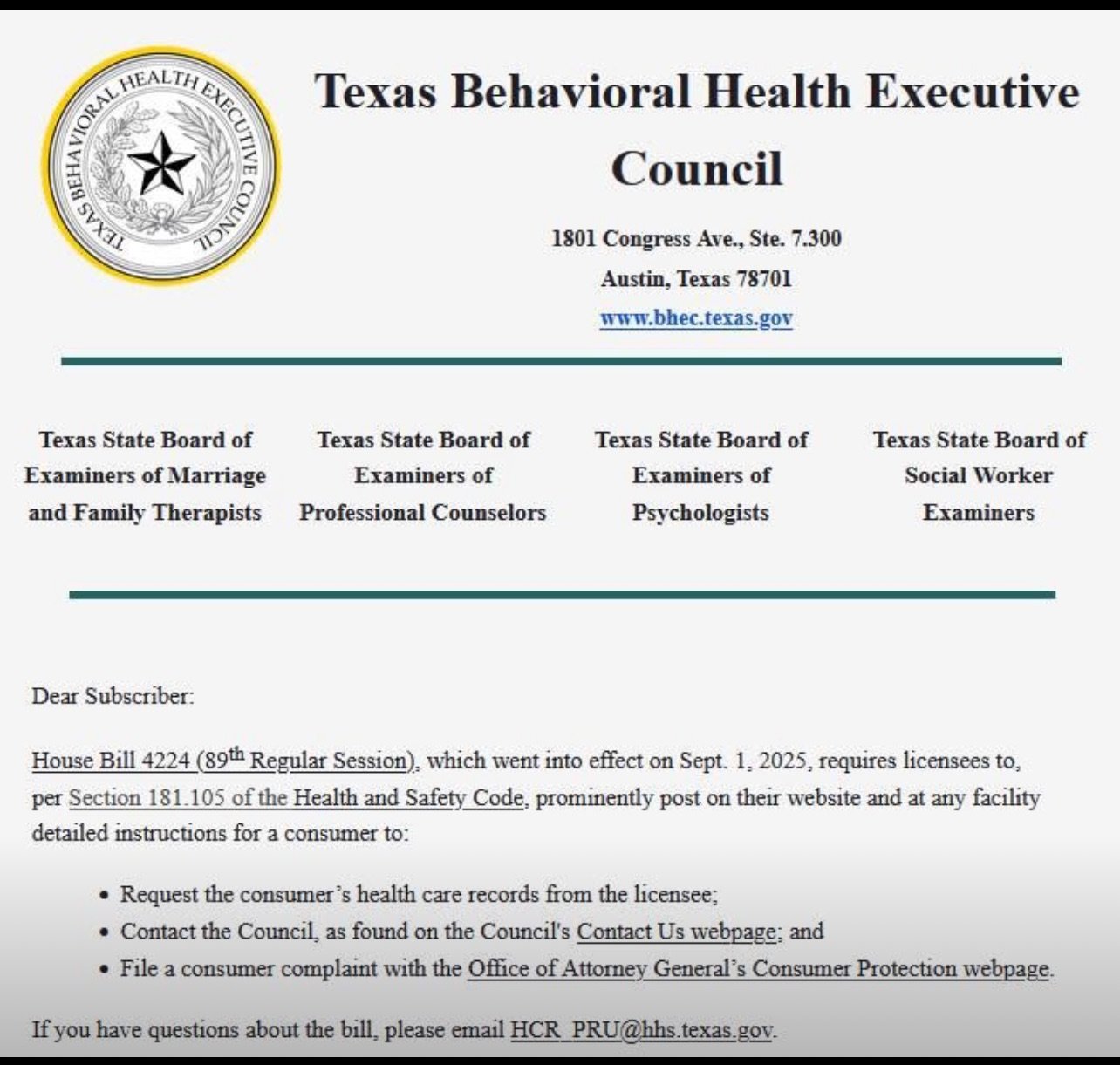
As of September 1, 2025, Texas behavioral-health licensees must prominently disclose how consumers can:
- Request their health-care records
- Contact the licensing authority (BHEC)
- File a complaint with the Texas Attorney General’s Consumer Protection Division
This information must appear:
- On the provider’s website
- And at any physical practice location
No disclosure?
That alone is a statutory violation.
No intent inquiry.
No clinical debate.
Just compliance—or the lack of it.
Why This Matters for ESA Letter Mills
Most online ESA platforms now repeat the same disclaimer:
“We don’t manage the clinical side.
We just connect consumers with licensed clinicians.”
That line is carefully crafted.
And it almost works.
Until the platform does the one thing it can’t disclaim away:
It warehouses the letter.
The Fatal Move: Warehousing the Letter
Across extensive testing of ESA platforms, one pattern keeps repeating:
- The platform disclaims responsibility for clinical care
- The clinician is distant, transient, or unreachable
- But the platform stores, controls, and reissues the ESA letter
That is not passive conduct.
Once a platform:
- stores the letter,
- timestamps it,
- re-downloads it,
- or markets it as “valid” or “compliant,”
it has taken custody of regulated clinical output.
At that point, “we’re just the connector” stops being true in any meaningful sense.
Here’s Where Litigation Exposes the Cracks
This isn’t theoretical anymore.
I currently have:
- multiple lawsuits active, and
- several more ready and waiting,
and every one of them shares the same core fact:
When formally asked—under conditions where production is required—none have produced the documents used to justify issuing the letter.
Not incomplete.
Not redacted.
Absent.
That matters.
Because a licensed professional issuing a disability-related letter has only two defensible positions:
- The documents exist and support the decision, or
- The documents do not exist, meaning the decision was not made in the ordinary course of professional care
There is no third option.
“Trust us” is not a record-keeping standard.
Neither is “that’s not our side of the business.”
HB 4224 Turns Absence Into Exposure
HB 4224 doesn’t require platforms to create clinical records.
It requires systems to tell the truth about how records can be accessed and challenged.
If a platform warehouses the letter but:
- cannot explain how underlying records are requested, or
- bounces consumers between a platform and an unreachable clinician,
then the required disclosures become false or misleading.
That’s no longer a clinical issue.
That’s consumer-protection exposure.
And once the same failure appears repeatedly, intent stops being speculative.
Why the “Connector” Defense Collapses
Regulators don’t care what you call yourself.
They care about functional reality.
They ask:
- Who took the money?
- Who controlled the workflow?
- Who stored and reissued the document?
- Who marketed legitimacy?
In ESA mills, the answer is almost never the clinician.
It’s the platform.
Warehousing the letter creates an implied representation:
“This document is legitimate and backed by real professional process.”
When that process can’t be produced—across case after case—that implication becomes indefensible.
This Isn’t About ESAs (And That’s the Point)
Texas didn’t touch the Fair Housing Act.
It didn’t redefine assistance animals.
It didn’t empower landlords.
Instead, it targeted the business mechanics that make thin documentation scalable.
That’s the lesson.
Bad systems don’t fail because someone argues with them.
They fail because someone asks to see the work.
The Stevens Method, Quietly Codified
This is the same approach we teach at REVOLT Training:
- Don’t argue outcomes → audit process
- Don’t accuse → trigger statutory duties
- Don’t moralize → stress-test compliance
HB 4224 doesn’t accuse anyone of fraud.
It just says:
“Here’s how consumers verify your claims.”
For systems built on missing justification, that’s enough.
Why This Matters Beyond Texas
This is post-Loper Bright governance in action.
No agency gloss.
No vibes.
No deference.
Just statutory text, disclosure duties, and consequences.
Texas may have stumbled into a model other states will follow:
- Transparency mandates
- Consumer-initiated enforcement
- AG-centric escalation
- Records as the choke point
That architecture travels.
The Takeaway
You don’t dismantle bad systems by banning them.
You dismantle them by forcing them to function as advertised.
Texas didn’t outlaw ESA letters.
It forced platforms to stand behind the process that supposedly produces them.
And when that process can’t be shown—
across lawsuit after lawsuit—
the system speaks for itself.
Want to learn how to identify these pressure points?
That’s what REVOLT Training teaches:
How to use statutes, records, and procedure—not outrage—to force accountability.
No protests.
No slogans.
Just process literacy.
Welcome to the quiet end of bullshit.
Help Keep the Pressure On
This work doesn’t run on vibes or hot takes. It runs on records requests, filing fees, expert review, and time. The lawsuits exposing these failures are active, real, and expensive—and they exist because someone is willing to do the unglamorous work of forcing systems to show their receipts.
If you think transparency matters, if you think professional claims should be backed by professional process, and if you want this pressure to continue, consider supporting the work. Donations go directly toward litigation costs, testing, and public-facing education—not overhead, not spin.
Accountability doesn’t fund itself.
If this work has value to you, help keep it moving.
Citations & Reference Links
The Statute: Texas HB 4224 (89th Legislature)
- Official Designation: Texas Health and Safety Code § 181.105
- Effective Date: September 1, 2025.
- Summary: Amends the Texas Medical Records Privacy Act to mandate that “covered entities” prominently post instructions on their websites and at physical facilities for:
- Requesting health care records.
- Contacting the licensing/disciplinary authority.
- Filing a complaint with the Attorney General
- Full Text Link: Texas Legislature Online – HB 4224 Enrolled Version
The Definition: “Covered Entity”
- Official Designation: Texas Health and Safety Code § 181.001(b)(2)
- Relevance: This is the “trap” for platforms. Texas defines a “covered entity” much more broadly than HIPAA. It includes any person or business that, for commercial gain, “assembles, collects, analyzes, evaluates, stores, or transmits protected health information.”
- The Argument: If a platform warehouses an ESA letter (which contains protected health information), they are functionally a “covered entity” under Texas law, regardless of their “we are just a connector” disclaimer.
The Enforcement Authority: Texas BHEC
- Agency: Texas Behavioral Health Executive Council (BHEC)
- Function: Oversees the licensing for psychologists, social workers, and counselors. Under HB 4224, the link to their Disciplinary and Complaint process must be prominent on any provider’s site.
The Escalation Pathway: Texas Attorney General (OAG)
- Division: Consumer Protection Division
- Complaint Portal: OAG Consumer Complaint Portal
- HB 4224 Specifics: The OAG is the primary enforcement arm for deceptive trade practices arising from failures to disclose these record-access rights.
About the Author

Chaz Stevens is the founder of REVOLT Training and a longtime public-records strategist focused on forcing accountability through process, not protest. His work has triggered policy reversals, criminal prosecutions, and national media coverage by weaponizing bureaucracy, public records laws, and First Amendment doctrine against institutional dysfunction.
Learn more about him on Wikipedia.
Learn more about him on Wikipedia.
Share
Sedition Isn't Free.
If these words have sparked something in you, help keep the fire burning. Since 2008, My Acts of Sedition (MAOS), the official blog of Revolt Training, is independent, unfiltered, and powered by the community—not corporate interests. Your support directly funds the infrastructure and training needed to turn ideas into action.
Fuel The Revolt
Go ahead, speak your mind.
Recent Musings
March 19, 2026
They Kept 23,000 Records About the Guy Who Tried to Ban the Bible
March 19, 2026
When a Commissioner From Another City Shows Up to Tell Yours to Stay Put — That’s a Records Request

March 11, 2026
[UPDATE]: Heritage Trap: How Florida’s Anti-DEI Law Eats Its Own
![Featured image for “[UPDATE]: Heritage Trap: How Florida’s Anti-DEI Law Eats Its Own”](https://research.revolt.training/wp-content/uploads/2025/10/4def8000-68aa-408a-8b3b-182a70bed3aa.jpeg)
February 10, 2026
The Viewpoint Neutrality Audit

Exposing Hypocrisy
One Story At A Time.
Media Hits
Let me teach you how to get in the news.
Press Hits
We'll Make You A Master Of The Media.

I Asked for an ESA Letter After a 10-Minute Chat. He Said Yes.
By Chaz Stevens Founder, REVOLT Training System Failure Boot Camp™ Want a letter for four emotional…

Investigating ESA Letter Abuse in California
This content is shared for public education, journalistic investigation, and policy advocacy. It includes direct communications…
California’s ESA Letter Scam: 15 Minutes, $149, No Care
This piece is a work of investigative commentary. All opinions expressed are those of the author…
How One Man (and One Bible Ban) Made DeSantis Blink
How Chaz Stevens Weaponizes Communication to Burn Systems Down (and Make DeSantis Blink) Forget influencer fluff.…
Burn the Letter Mill Down: How One $99 ESA Letter Could Crater an Industry.
Ever buy a disability accommodation letter in under 2 minutes? I did. That’s how this story…

I’m calling Austin’s bluff on the Ten Commandments | The Dallas Morning News
by Chaz Stevens Dallas Morning News Soon, Gov. Greg Abbott will sign Senate Bill 10 into…